San Diego Wine Country vs Temecula: Which Is Better for Your Wine Trip?

San Diego wine country and Temecula are both within an hour of downtown San Diego. Both have established wine regions, multiple tasting rooms, and weekend crowds. But they offer completely different experiences — and depending on what you’re looking for, one is significantly better than the other.
This is the honest comparison. Not a tourism piece. Just the actual differences between the two regions so you can make an informed decision before you book your weekend.
The Basic Geography
Temecula Valley sits about 60 miles north of downtown San Diego in Riverside County, just off the I-15. It’s a large, well-developed wine region with 40+ wineries concentrated in a relatively small area, strong infrastructure, and heavy tourism traffic. Drive time from downtown San Diego is 60 to 75 minutes depending on traffic.
San Diego wine country is spread across four distinct regions within San Diego County — Ramona Valley (45 minutes northeast), San Pasqual Valley (30 minutes northeast), Julian (60 to 75 minutes), and Fallbrook (60 to 70 minutes north). The regions are more dispersed than Temecula, but each has its own character.
For the full geography of San Diego’s wine regions, see the San Diego wine trail guide.
The comparison at a glance
| Temecula Valley | San Diego County | |
|---|---|---|
| Wineries | Around 50 in the AVA | 73 in our directory, across eight regions |
| AVA established | 1984 | Ramona Valley 2006; San Pasqual Valley 1981 |
| Typical tasting fee | $20–30, some flagship estates $35–50+ | $15–22, frequently waived with a bottle |
| Opening days | Most open daily, roughly 11am–5 or 6pm | Many open Friday–Sunday only; some by appointment |
| Drive from downtown SD | About an hour up I-15 | 35–45 minutes to the main regions |
| Food on site | Common — several full restaurants | Rare — picnics usually welcome instead |
| Lodging | Resorts, spas, hotels in the valley | Essentially none at the wineries |
| Who pours your wine | Usually tasting room staff | Often the person who made it |
Wine Quality: The Honest Assessment
This is where the comparison gets interesting. Temecula produces good wine — approachable, food-friendly, and well-suited to the mass tasting room market. The region’s warmer, lower-elevation growing conditions favor Rhône varieties, some Mediterranean whites, and accessible reds that drink well young.
San Diego’s Ramona Valley operates at significantly higher elevation (1,400 to 2,800 feet) with more extreme diurnal temperature swings — the same conditions that produce world-class wines in cooler European appellations. The result is Zinfandels, Syrahs, and Bordeaux-style reds with real structure, complexity, and genuine aging potential that Temecula wines rarely match.
The honest verdict: for serious red wine, San Diego’s best producers — Vineyard Grant James, Shadow Mountain Vineyard, and others in Ramona — consistently outperform Temecula at equivalent price points. Temecula has scale and accessibility. San Diego has the better wine.
The Tasting Room Experience
Temecula’s tasting rooms are polished, well-staffed, and built for volume. Many offer food, live music on weekends, event spaces, and the full resort-winery experience. If you want a big, festive wine country day with lots of people and a party atmosphere, Temecula is the right choice.
San Diego’s tasting rooms are smaller, owner-operated, and quieter. You’re more likely to meet the winemaker, get a personalized pour, and have the terrace largely to yourselves. The experience is more intimate and often more educational — but it requires more planning because the wineries are smaller and reservations fill faster.
For date nights, anniversary trips, and visits where the quality of the wine and the intimacy of the experience matter, San Diego wins. For big group celebrations with a festive atmosphere, Temecula is the easier choice. See the San Diego wineries for groups guide for the best options when you need both.

Crowds and Vibe
Temecula on a Saturday in summer is genuinely crowded. The main wine corridor can feel more like a theme park than wine country — shuttle buses, Instagram stops, party buses, and lines at the more popular tasting rooms. It can be fun, but it’s a specific kind of fun that not everyone is looking for.
San Diego wine country on the same Saturday is quieter. Ramona Valley tasting rooms are busy but not overwhelming. The back roads between wineries feel like actual wine country. You’ll hear more birds than party buses. If peace and quiet matter to your wine experience, San Diego wins by a significant margin.
Price and Value
Tasting fees in Temecula have crept up as the region’s tourism profile has risen — $25 to $40 per person is now common, and some higher-profile operations charge more. The wines themselves are priced competitively with the California market.
San Diego tasting rooms typically run $15 to $30 per person, and the wines — particularly from the Ramona Valley’s best producers — over-deliver relative to their price tags. The value proposition in San Diego is genuinely better for the serious wine drinker.
Where Temecula genuinely wins
It is built for visitors, and that matters more than wine snobs admit. You can book a hotel in the valley, walk to dinner, take a balloon ride at dawn, and never move your car. Several wineries run proper restaurants rather than a cheese plate. If you are organising a weekend for six people with varying levels of interest in wine, Temecula removes almost every logistical problem.
It is open when you are. Most Temecula tasting rooms open seven days a week. This sounds minor until you have driven forty-five minutes into Ramona on a Wednesday and found three locked gates.
The density is real. Rancho California Road strings wineries together closely enough that you can visit four in an afternoon without the drive becoming the day’s main activity.
And the wines are not a compromise. Temecula grows the same Mediterranean varietals that suit this climate — Sangiovese, Grenache, Tempranillo, Vermentino, Petite Sirah — and does it at a scale that has produced genuinely accomplished bottles. Anyone who dismisses Temecula wholesale has usually not tasted much of it.
Where San Diego County wins
Scale, inverted. The average San Diego tasting room seats a few dozen people. In Ramona Valley you will frequently be poured by the winemaker, standing next to the tanks, and the conversation will not be a script. That is not a marketing claim — it is a consequence of most of these being family operations with no hospitality staff to hide behind.
Cost. Tasting fees run $15–22 against Temecula’s $20–30, and waiving the fee with a bottle purchase is common practice here in a way it historically has not been in Temecula. Across three stops for two people, that difference is real money.
Proximity. Escondido is 35 minutes from downtown San Diego, Ramona about 45. Temecula is an hour, and the last stretch of I-15 on a Sunday afternoon is not a pleasant drive.
Genuine oddities in the glass. Ramona Ranch grows Tannat, a thick-skinned, tannic Basque grape almost nobody in Southern California attempts. Domaine Artefact in Highland Valley grows Fiano and Dolcetto alongside Sangiovese and Barbera. Bastian’s runs Rhône varietals — Grenache, Mourvèdre, Viognier. These are not safe commercial choices. They are the plantings of people following curiosity rather than a business plan, and they are the reason serious drinkers come out here.
Elevation. Ramona’s vineyards sit between 1,400 and 2,800 feet, higher than most of Temecula. The extra elevation widens the day-night temperature swing, and you can taste it in the acidity. Milagro and Sky Valley Cellars sit near the top of that range.
Practical differences worth planning around
Check opening days before you drive. This is the single biggest practical gap. Temecula assumes you might turn up on a Tuesday. Much of San Diego County does not. Always check the individual listing.
If San Diego wins your vote: the itinerary builder turns the county into a routed day, the San Diego Wine Map puts all 117 venues in your pocket, the Insider’s Guide covers the 25 worth planning around, and the deals page lists current tasting offers. For either region, the wine travel gear guide handles the bottles on the drive home.
Reservations. Temecula’s larger estates take walk-ins comfortably; weekends at popular wineries are worth booking. In San Diego, the smaller producers are the ones more likely to require an appointment — the opposite of what you might expect.
Food. In Temecula, plan around a winery restaurant. In San Diego, bring a picnic — most estates welcome outside food, and only a handful have kitchens. Cordiano in Escondido is the notable exception, with a full Italian kitchen. Orfila has food service and grounds large enough for a group.
Driving. Both need a designated driver. Temecula has better rideshare coverage and more organised tour operators. Ramona’s rural roads have thin coverage and deserve a sober driver after dark.
Dogs. San Diego is unusually accommodating — Chuparosa, Hatfield Creek and Cheval all welcome dogs. Worth checking individual Temecula estates, as policies vary more there.
The Verdict: Which Should You Choose?
Choose San Diego wine country if: You want the best possible wine, a more intimate experience, quieter settings, better value, and you’re willing to plan ahead and make reservations.
Choose Temecula if: You want a festive group outing, resort-style amenities, walk-in availability, or you’re visiting with people who are more interested in the event than the wine.
Do both if: You have a full weekend. Saturday in Temecula for the big, festive experience. Sunday in Ramona Valley for the wine that actually stays with you.
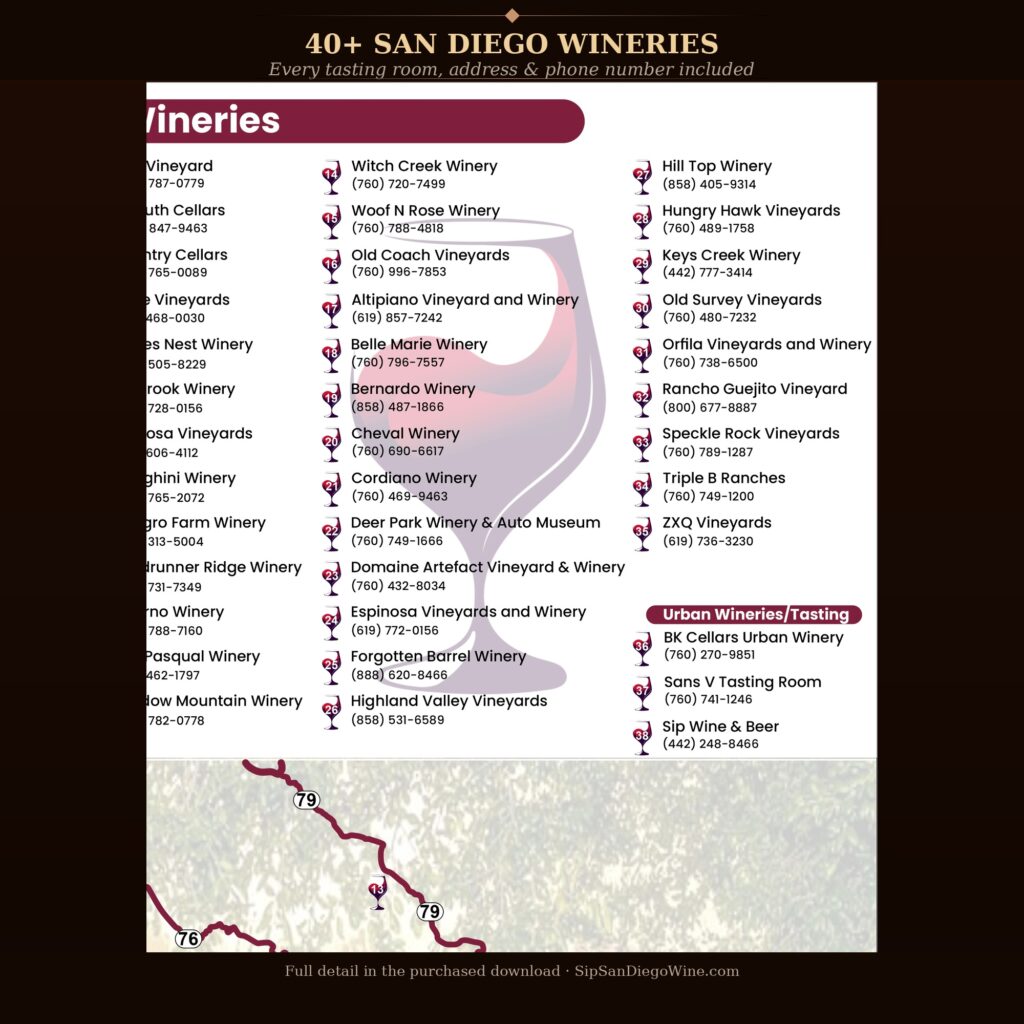
For planning any San Diego wine country visit, the Sip San Diego Wine Map is the essential tool — every tasting room in the county mapped with routes, drive times, and the local context that makes the difference between a good trip and a great one. See the San Diego wine country weekend itinerary for a ready-made two-day plan.
To stay current on what’s happening across San Diego wine country — new openings, harvest events, and the best tasting room experiences month by month — join the Sip San Diego newsletter. One focused email per week, zero noise.
Frequently asked questions
Is Temecula or San Diego better for wine tasting?
Temecula is better for a first visit, a group, a midweek trip, or an overnight stay — it has more wineries, longer hours, and real hospitality infrastructure. San Diego County is better for smaller, more personal tastings, lower fees, and unusual varietals. Most people who do both end up preferring Temecula for the occasion and San Diego for the wine.
How far is Temecula from San Diego?
About 60 miles, or roughly an hour up I-15 from downtown in clear traffic. Sunday afternoons southbound can add substantially to that. From North County coastal towns it is closer to 40 minutes.
Is Temecula wine actually good?
Yes, and the reflexive dismissal of it is lazy. Temecula’s climate suits Mediterranean varietals — Sangiovese, Grenache, Tempranillo, Vermentino, Petite Sirah — and the better producers make serious wine from them. What Temecula also has is a large volume of sweet, commercial bottlings aimed at first-time visitors, which is what most critics are actually reacting to. Taste at the estates that grow their own fruit and the picture changes.
Can you visit both in one day?
Yes, if you use Fallbrook as the bridge. It sits in northern San Diego County about twenty minutes from Temecula, so a route running Fallbrook then Temecula — or the reverse — is comfortable. Temecula to Ramona is around fifty minutes, which is doable but leaves little time in either region; that pairing works better as two separate days.
Which is cheaper?
San Diego County, by a meaningful margin once you add up a full day. Tasting fees run roughly $15–22 here against $20–30 in Temecula, waiving the fee with a bottle purchase is more common, and you are not paying for lodging if you live in the county. A three-stop day for two costs roughly $120–160 in Ramona against $150–200 in Temecula before food.
Does San Diego County have a real AVA?
Three. San Pasqual Valley was designated in 1981 — three years before Temecula — Ramona Valley in 2006, and San Luis Rey, covering Fallbrook and the San Luis Rey River valley, in 2024. All three sit within the same South Coast AVA that contains Temecula Valley.
If you are coming to San Diego
Start with Escondido if you want the easier introduction — eighteen wineries, short drives, and the county’s one proper winery restaurant. Go to Ramona Valley if you want the small, personal version, and go on a weekend. The Ramona Valley Wine Trail Guide maps three suggested routes.
Our free trip planner builds a route with arrival times and a cost estimate. You can also browse the full San Diego winery directory, see all eight regions, or read our roundup of the best wineries in San Diego.